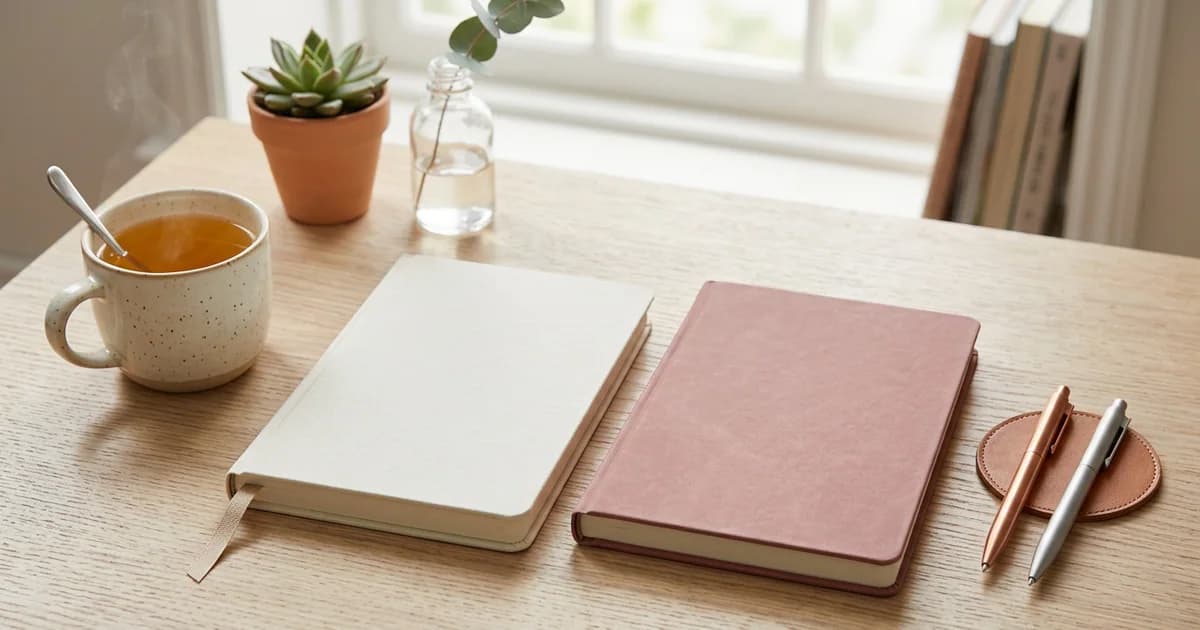

You bought the journal. You carved out five minutes. And then... nothing. The blank page stares back. You know gratitude is good for you — the research is undeniable — but knowing and doing are different things.
The problem isn't your motivation. It's your prompts. When you don't know what to write, your brain defaults to the same three answers: family, health, job. There's nothing wrong with those, but repeating them daily doesn't deepen the practice. It becomes checkbox gratitude — mechanical, not transformative.
What follows are fifty prompts organized by intention. Some build the habit. Some deepen self-awareness. Some reframe struggle. All are grounded in positive psychology research and designed to make your daily practice something you look forward to, not another task on your list.
Why Prompts Matter: The Science
Dr. Robert Emmons, the world's leading gratitude researcher, found in his landmark 2003 study that participants who wrote about gratitude weekly for ten weeks experienced 25% greater happiness, exercised 1.5 hours more per week, and had fewer physical complaints. But here's what often gets missed: the participants who benefited most weren't the ones who wrote "I'm grateful for my family" every week. They were the ones who explored why they were grateful, how it changed them, and what life would be like without that blessing.
Prompts serve as cognitive scaffolding. They guide your attention to aspects of experience you'd otherwise overlook. A 2018 study in the Journal of Positive Psychology found that participants who used varied gratitude prompts showed significantly greater gains in life satisfaction than those who used a single open-ended format. Variety prevents hedonic adaptation — the tendency for any practice to lose impact through repetition.
The prompts below are organized into five categories, each targeting a different neural pathway:
- Daily Anchors — Simple prompts for building the habit
- Deep Reflection — Prompts that reveal patterns and meaning
- Reframing Challenges — Finding gratitude in difficulty
- Social Connection — Gratitude focused on relationships
- Sensory Awareness — Embodied gratitude for physical experience
Daily Anchors: Prompts for Building the Habit
Use these when you're starting out or when energy is low. They require minimal cognitive effort but still activate gratitude circuitry.
1. What made you smile today, however briefly?
2. What is one thing in this room you're glad exists?
3. What did you eat today that you enjoyed?
4. What is one small convenience of modern life you used today?
5. What is something you're looking forward to?
6. Who did you interact with today, and what was good about it?
7. What is one thing your body did for you today?
8. What is a sound you heard today that was pleasant?
9. What is something you learned today?
10. What is one way today was slightly better than yesterday?
Deep Reflection: Prompts That Reveal Patterns
These prompts require more contemplation. Use them when you have ten minutes and want to go deeper.
11. What is something you now have that you once desperately wanted?
12. Who has shaped you most, and what specifically did they teach you?
13. What is a mistake that ultimately led to something good?
14. What aspect of your personality are you grateful for?
15. What is something beautiful you witnessed this week?
16. What challenge made you stronger?
17. What is a freedom you have that not everyone enjoys?
18. What is something you created that you're proud of?
19. What have your parents or caregivers given you that you now appreciate?
20. What is a habit you have that serves you well?
Reframing Challenges: Gratitude in Difficulty
Research by Dr. Sonja Lyubomirsky shows that finding benefit in adversity is one of the strongest predictors of post-traumatic growth. These prompts aren't about toxic positivity — they're about honest recognition that difficulty often carries unexpected gifts.
21. What is something hard you're going through, and what is one small resource you have to face it?
22. What did a past struggle teach you that you use today?
23. Who showed up for you during a difficult time?
24. What is one thing you understand now that you didn't before your last major challenge?
25. What is a limitation that has forced you to develop a strength?
26. What is something painful that you would not undo because of what it taught you?
27. Who is someone you forgave, and what did forgiveness free you to feel?
28. What is a rejection that redirected you toward something better?
29. What is a fear you faced, and what opened up on the other side?
30. What is one way a loss changed your priorities for the better?
Social Connection: Gratitude Focused on Relationships
The Harvard Study of Adult Development — the longest-running study on human happiness — found that warm relationships are the single strongest predictor of lifelong wellbeing. These prompts direct your attention to the people who matter.
31. Who made you feel seen this week?
32. What is something kind someone did that they probably forgot about?
33. Who believes in you even when you don't believe in yourself?
34. What is a quality you admire in your closest friend?
35. Who has challenged you to grow, even if it was uncomfortable?
36. What is a memory with a loved one that still warms you?
37. Who accepts you exactly as you are?
38. What is something you love about your community or neighborhood?
39. Who has forgiven you, and what did that teach you about grace?
40. What is a tradition or ritual you share with someone that you cherish?
Sensory Awareness: Embodied Gratitude
Mindfulness research shows that directing attention to physical sensation anchors gratitude in the body, making it more vivid and memorable than abstract reflection alone.
41. What is something comfortable you're wearing or sitting on right now?
42. What did you taste today that was delicious?
43. What is a scent that brings you peace?
44. What is something you can see right now that is beautiful?
45. What physical sensation feels good in your body right now?
46. What is a texture you enjoy touching?
47. What is your favorite time of day, and what makes it special?
48. What is a place in nature you love, and what does it feel like to be there?
49. What is one way your body carried you through today?
50. What is something you can hear right now that connects you to the world?
How to Use These Prompts Effectively
Don't do all fifty at once. Choose one category per week. Rotate through them. The goal isn't completion — it's depth.
Write for two minutes minimum. Research by Dr. Laura King shows that even brief gratitude writing produces measurable mood improvements, but the effect strengthens with duration up to about ten minutes.
Be specific, not generic. "I'm grateful for my sister because she texted me a meme that made me laugh during a hard day" creates more neural activation than "I'm grateful for family."
Include the "why." After each prompt answer, add one sentence about why this matters to you. This simple addition transforms checkbox gratitude into transformative reflection.
Key Takeaways at a Glance
| Habit/Strategy | Core Benefit | Time Investment | Research Support |
|---|---|---|---|
| Habit 1: Morning Meditation | Reduced stress | 10 min/day | Strong |
| Habit 2: Gratitude Journaling | Increased optimism | 5 min/day | Strong |
| Habit 3: Regular Exercise | Better mood | 30 min/day | Very Strong |
| Habit 4: Quality Sleep | Emotional stability | 7–9 hours | Very Strong |
| Habit 5: Social Connection | Longevity | Varies | Strong |
Helpful Tools for Cultivating Gratitude
This book by Janice Kaplan provides a practical guide to incorporating gratitude into daily life, offering real-life experiences and research to inspire readers to appreciate the small moments that contribute to overall happiness.
View on Amazon →This journal by Tamara Levitt is designed to help readers develop the habit of gratitude by providing daily prompts and reflections, thus deepening their practice and helping them to see the positive aspects of each day.
View on Amazon →This journal by Christine Michel Carter is structured to guide users through a year of gratitude practice, with weekly prompts that encourage exploration of different aspects of life to build a more transformative gratitude habit.
View on Amazon →Frequently Asked Questions
How many prompts should I do per day?
One is enough. Quality beats quantity. A single deeply considered prompt creates more benefit than ten rushed answers.
What if I can't think of anything?
Start with sensory prompts (#41-50). They're the easiest because they don't require abstract reflection — just notice what's physically present.
Should I do this in the morning or evening?
Morning practice sets a positive tone for the day. Evening practice improves sleep quality. Experiment with both and see what fits your rhythm.
How long before I notice results?
Most studies show measurable mood improvements within two weeks of consistent practice. Deeper shifts in outlook typically emerge after six to eight weeks.
Can I use these in any journal?
Absolutely. While structured journals like The Five Minute Journal provide helpful frameworks, any blank page works. The prompt matters more than the format.
Start Tonight
You don't need the perfect journal, the ideal time, or a life free of problems. You need one prompt, two minutes, and honesty. Pick number one — what made you smile today? — and write until the answer surprises you. That's where the practice begins.
For a complete guide to building the gratitude habit, see our article on how to practice gratitude daily. And if you need a journal to hold these reflections, we've tested the best gratitude journals hands-on to help you choose.
Frequently Asked Questions
What are the benefits of keeping a gratitude journal?
How often should I write in my gratitude journal?
Is it okay to repeat gratitude journal entries?
What if I don't feel grateful? Should I still write?
Do I need to write a lot or can I keep it short?
Can I use digital tools or apps for my gratitude journal?
What's the best time of day to write in my gratitude journal?
How can I get started with my first gratitude journal entry?
Weekly happiness in your inbox
One practical idea every week. No spam and no miracle claims — just clear advice you can assess for yourself.
No spam. Unsubscribe anytime.
Marcel Kupures
Founder & Editor
Founder and editor of Get A Happy Life. Research references are linked where they are used, and product comparisons rely on public product information unless hands-on testing is explicitly documented.
Last updated: June 25, 2026
Want more happiness science?
Browse all our guides on mindfulness, gratitude, sleep, and well-being.
Read more guides