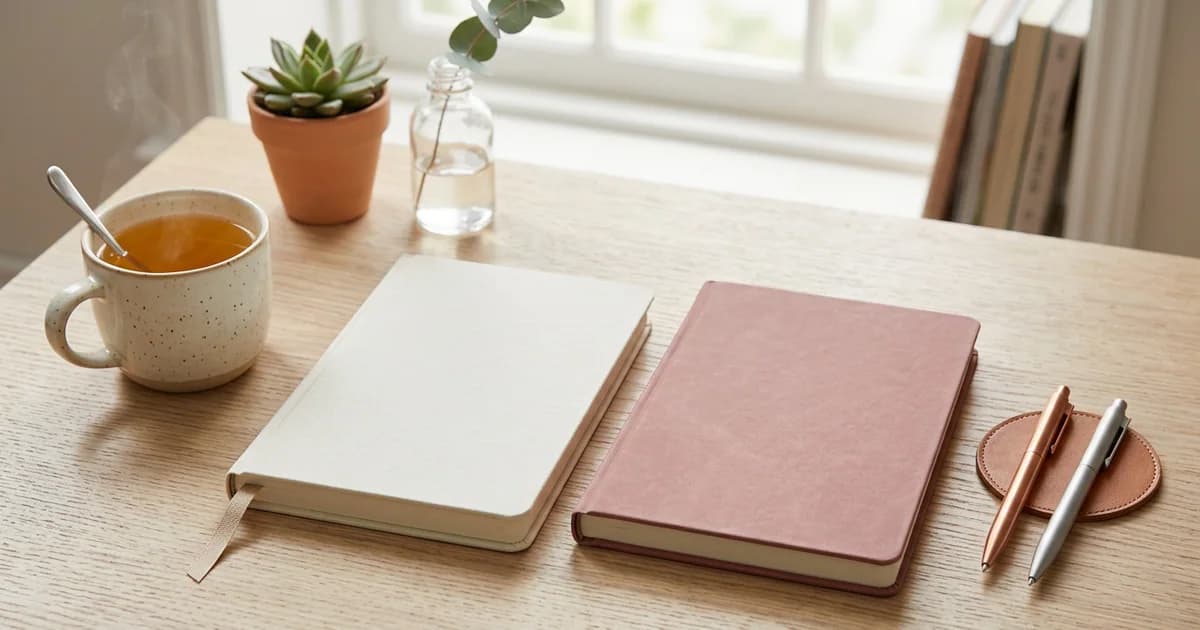
A gratitude journal is a specific daily practice: you write down what you are thankful for, typically three to five things, as a way of training your attention toward what is already good in your life. A happiness journal is a looser marketing label applied to a wider category of wellbeing notebooks that can include mood tracking, affirmations, goal setting, reflection prompts and creative exercises. The two overlap, but they are not the same thing.
If you want a focused, low-friction daily habit, a gratitude journal is the cleaner choice. If you want something that also covers goals, habits or deeper self-reflection, a happiness journal or wellbeing planner is closer to what you need. Before you buy, browse our gratitude and happiness journal comparison to see which formats fit the way you actually live.
What a gratitude journal actually is
A gratitude journal has one clearly defined purpose: directing your attention toward what is already working in your life. The core practice is writing down things you are grateful for, usually at the same time each day, most often in the morning or just before bed. Some gratitude journals give you a blank page and nothing else. Others, such as The Five Minute Journal by Intelligent Change, build the practice into a repeating structure of morning and evening prompts, removing blank-page paralysis and making the habit easier to maintain.
The simplicity is the point. You are not expected to write at length or explore complicated feelings. A well-designed gratitude journal asks you to name a few specific things, notice something good that happened, and move on with your day. For a deeper look at the thinking behind this kind of practice, see the science of gratitude.
What people mean by a "happiness journal"
"Happiness journal" is a phrase that publishers and stationery brands use to sell a wide variety of notebooks. A product carrying that label might include daily mood ratings, weekly reflection questions, affirmations, visualisation exercises, long-form free writing pages, or pages dedicated to goals and habits. The Law of Attraction Planner by Freedom Mastery, for example, pairs daily gratitude prompts with a goal-setting structure, making it as much a planner as a journal.
The label also covers lighter formats. Q&A a Day from Potter Style asks one short question per day and repeats the same question across five years, so you can watch your answers evolve without any pressure to write at length. Start Where You Are from Perigee Books rotates creative prompts for days when you feel stuck. Neither would accurately be called a gratitude journal, even though gratitude appears on some of their pages.
The practical differences that decide which one you will keep using
The format you actually return to tomorrow matters more than the one that looks most inspiring on the shelf. The table below breaks down the five differences worth checking before you buy.
| Gratitude journal | Happiness journal | |
|---|---|---|
| Focus | What you are thankful for | Mood, goals, habits, reflection, affirmations |
| Daily time | Five to ten minutes | Varies, can be ten to thirty minutes |
| Prompt style | Repeating, short, low effort | Varied, sometimes multi-step exercises |
| Dated or undated | Often undated | Mixed, depends on the product |
| Who it suits | Anyone wanting a simple daily habit | People who want structure across multiple life areas |
Prompt style is where most people go wrong. Structured journals that pack in mood trackers, affirmation boxes and multiple daily ratings can feel like a performance review rather than a quiet ten minutes with your thoughts. A recurring discussion on Mumsnet captures this exactly: buyers of structured wellbeing notebooks reported that the experience felt more like hard work than settling down, and many gave up and resold the books within a few weeks. If you recognise that tendency in yourself, a simpler format will serve you far better.
Dated or undated: the thing most buyers regret
A dated journal gives you a pre-printed date on every page. It feels organised, but the moment you miss a day, that blank page becomes a visible record of failure rather than a minor interruption. On Mumsnet's wellbeing threads, this is a recurring theme: the fixed-date format turns a skipped day into a sense of having already ruined the journal, and many people stop using it entirely rather than carry on past the gap.
An undated journal lets you pick up on your own schedule without that pressure. Both The Five Minute Journal and the Clever Fox Premium Life Planner are undated for exactly this reason. If your routine is irregular, if you travel, or if you know from experience that you are not consistent every single day, prioritise undated. You can always write the date yourself. You cannot easily undo the discouragement of a long run of blank pre-printed pages staring back at you.
When a happiness journal backfires
The gap between a product's cover and its contents can be wider than buyers expect. Journals branded around happiness often use bright colours, cheerful typography and language about joy and positivity. But the exercises inside sometimes ask you to examine anxiety, unresolved feelings or difficult patterns in your thinking. On Goodreads, readers have noted this mismatch: cheerful packaging set one expectation and the prompts delivered something more confronting than anticipated. That is not necessarily a flaw, but if you are expecting light daily check-ins and you get exercises that surface something hard, the experience can feel like a bait-and-switch.
A similar pattern appears when journaling becomes required or performative. When a workplace or group setting makes gratitude writing feel like an obligation, it tends to produce resistance rather than genuine reflection. A widely shared thread on Mumsnet about being told to keep a gratitude journal makes clear that the practice produces very different results when it is imposed rather than chosen.
It is also worth being honest about something the wellness market tends to sidestep: journaling is not a treatment for depression, anxiety or other mental health conditions. It can be a helpful supplement alongside professional support, but if you are struggling, speaking to a doctor or therapist is the right first step. For a broader look at caring for yourself in a grounded way, see how to practice self love. For the sceptical version of that question, see does journaling help mental health.
Is a branded journal worth it, or is a plain notebook enough
A plain notebook works. There is no ingredient in a branded journal that a ruled notebook cannot replicate if you already know what you want to write. On Teamblind, a recurring question in productivity discussions asks whether a specific product is needed before starting, and the most common reply is that a cheap notebook is fine and that the ritual matters more than the paper.
The value of a structured journal is that it removes blank-page paralysis and builds a repeating habit through prompts. If that scaffolding genuinely helps you sit down and write, the product earns its place. If you are disciplined enough to write freely without guidance, a plain notebook costs almost nothing and imposes no fixed format on your thinking.
Where premium brands do attract legitimate complaints is in the buying experience rather than the content itself. Reviews on Trustpilot for wellbeing planner brands tend to focus on delivery problems, unexpected costs and customer service issues. The notebooks inside are rarely the complaint.
Which one should you buy
The decision comes down to what you actually want to do each day. Here is a short list to make it concrete.
- You want a simple gratitude practice under ten minutes: The Five Minute Journal by Intelligent Change is the clearest match. Structured morning and evening prompts, no blank-page paralysis, and it is undated.
- You want gratitude plus goal setting in one book: The Law of Attraction Planner by Freedom Mastery combines both in a hybrid format that doubles as a planner.
- You want a light daily prompt with no pressure to write at length: Q&A a Day gives you one question per day and builds a five-year record of your answers automatically.
- You keep running out of things to write: Start Where You Are from Perigee Books offers rotating creative prompts for exactly this situation.
- You want more page space for free writing: The Papier Gratitude Journal in the Morning Pages format gives you longer pages for extended, unstructured reflection.
- You want habit tracking, goals and gratitude in one undated system: The Clever Fox Premium Life Planner covers that combination. See our life planner comparison or the head-to-head The Five Minute Journal vs Clever Fox Planner to judge which suits your style.
For the full breakdown of formats, prompts and how each journal fits different habits, see our gratitude and happiness journal comparison.
Frequently asked questions
The questions readers ask most before buying, answered directly.
Is a happiness journal the same as a gratitude journal?
No. A gratitude journal has a single focus: writing down what you are thankful for. A happiness journal is a marketing label that covers a wider range of notebooks, including mood trackers, affirmation books, goal planners and creative prompt journals. Some happiness journals include gratitude pages, but the two categories are not interchangeable, and the differences in daily format and time commitment are significant.
What is the best journal to write in for women?
The best journal depends on your habit style, not your gender. That said, searches for journals aimed at women tend to surface products with more structured prompts and considered design. The Five Minute Journal, the Papier Gratitude Journal and Start Where You Are are all commonly mentioned in that context. Choose based on how much structure you want and how long you realistically have each day.
Does journaling help mental health?
Regular journaling is associated with benefits such as reduced stress and greater emotional clarity, but it is not a substitute for professional mental health care. If you are experiencing depression, anxiety or anything that is getting in the way of daily life, speak to a doctor or therapist first. Journaling can be a useful supplement alongside that support, not a replacement for it.
Should I get a dated or undated journal?
Unless your daily routine is very consistent, undated is the safer choice. Dated pages create a visible record of missed days, which leads many people to abandon the journal rather than carry on past a gap. An undated journal lets you return on your own schedule without the sense that the book is already behind. You can always add the date yourself when you sit down to write.
How long should I journal each day?
Five to ten minutes is enough for a structured gratitude practice. Longer free-writing sessions are useful for working through complex thoughts, but they are not necessary for the habit to produce results. Consistency on most days matters more than the length of any single session. Starting short also makes it far easier to keep the habit when your schedule changes.
Can I just use a notebook instead?
Yes. A plain notebook works perfectly well. The advantage of a structured journal is that it removes blank-page paralysis and builds a routine through repeating prompts. If you are disciplined about what you want to write and do not need that scaffolding, a plain notebook is a practical and low-cost starting point. Many people begin with a notebook and move to a structured journal once they know which format suits them.
Weekly happiness in your inbox
One practical idea every week. No spam and no miracle claims, just clear advice you can assess for yourself.
No spam. Unsubscribe anytime.
Marcel Kupures
Founder & Editor
Founder and editor of Get A Happy Life. Research references are linked where they are used, and product comparisons rely on public product information unless hands-on testing is explicitly documented.
Last updated: September 15, 2026
Want more happiness science?
Browse all our guides on mindfulness, gratitude, sleep, and well-being.
Read more guides