Creative hobbies lower cortisol and reduce anxiety and depression symptoms while creating a state of deep focus called flow. This absorbed attention gives your mind a break from rumination, increases positive affect and feelings of flourishing, and provides a form of mindfulness through gentle, active focus. No talent or experience is required—the act of making is what matters.
- Lower cortisol, reduce anxiety and depression symptoms
- Create flow state with absorbed focus and mindfulness
- Increase positive affect and feelings of flourishing
- No talent or prior experience required to start
- Structured activities ease entry for anxious people
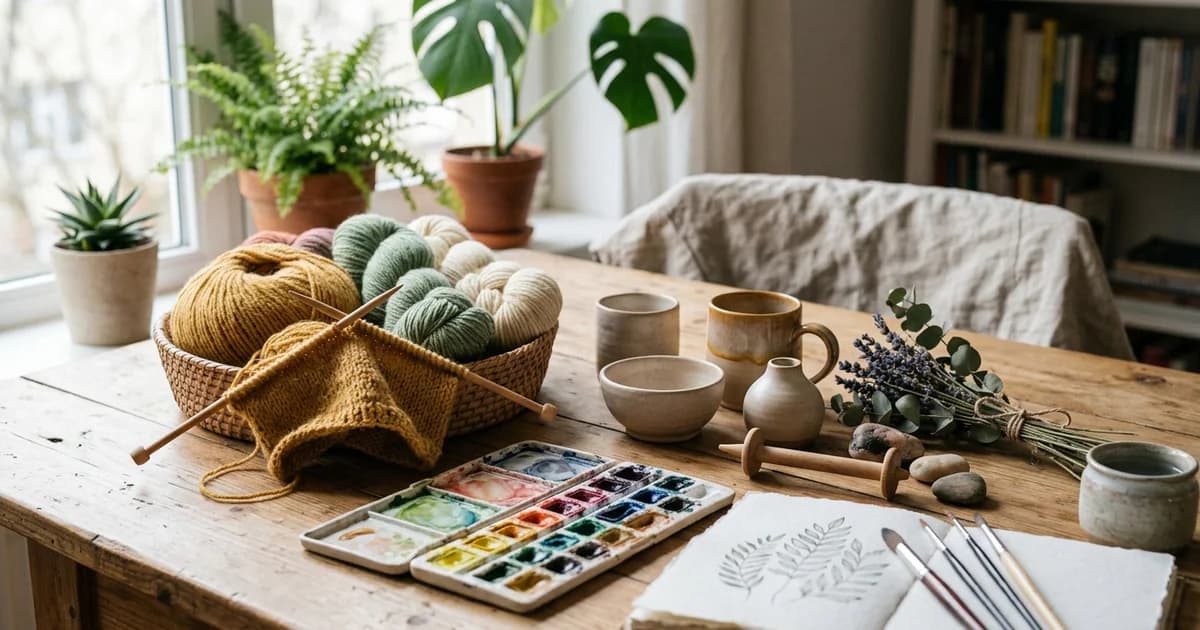
There's a particular kind of calm that settles over you when you're making something with your hands. Maybe it's the slow rhythm of knitting needles clicking together, or the way a watercolor bleeds across wet paper in exactly the right direction. Whatever the medium, something shifts in your brain when you're creating — and it turns out science has a lot to say about why that happens.
Creative hobbies for mental health aren't just a nice idea or a trendy wellness concept. Researchers have found real, measurable benefits from regular creative activity: lower cortisol levels, reduced symptoms of anxiety and depression, improved focus, and a stronger sense of identity and purpose. Making things — whether that's a drawing, a knitted scarf, or a page filled with color — activates a kind of deep, absorbed focus that gives your ruminating mind a genuine break.
This article looks at three of the most accessible creative hobbies for mental health, with specific product picks to help you actually get started. No art degree required, no prior experience needed. Just you, some materials, and the quiet satisfaction of making something with your own hands. Here's what's worth trying — and what to grab first.
Quick overview: the best creative hobby supplies for mental health at a glance
Johanna Basford — Lost Ocean Coloring Book
The most beautifully designed adult coloring book available — intricate ocean scenes that pull you into a meditative flow state within minutes.
View on Amazon →Arteza Watercolor Paint Set — 36 Colors
A highly rated beginner watercolor set with vibrant, easy-to-blend colors that makes the learning curve feel genuinely enjoyable rather than frustrating.
View on Amazon →Complete Beginner Knitting Kit — Needles, Yarn & Guide
Everything a beginner needs to start knitting in one box, with chunky yarn that makes your first project feel achievable right away.
View on Amazon →Why creative hobbies are so good for your mental health
Before getting into the specific picks, it's worth understanding why making things affects the brain the way it does. Psychologist Mihaly Csikszentmihalyi described it as "flow" — a state of total absorption where self-consciousness drops away and time seems to pass differently. Creative activities are among the most reliable ways to reach that state, especially when they're tactile and rhythmic.
A 2016 study published in the Journal of Positive Psychology found that people who engaged in creative activities daily reported higher positive affect and feelings of flourishing the following day. Another study from 2015 found that people with access to regular creative expression had significantly lower levels of the stress hormone cortisol. These aren't small effects — and they don't require talent. The act of making is what matters, not the quality of the result.
There's also something worth noting about the kind of attention creative hobbies demand. Unlike scrolling through a phone or watching TV — both of which are passive and often leave you feeling flat — making something requires active, gentle focus. You have to be present. That presence is, in itself, a form of mindfulness. Which is probably why so many therapists now recommend creative hobbies as a complement to other mental health practices. If you're already working on building better daily habits, adding a creative practice is one of the most enjoyable ways to do it — more on that in our guide to how to build good habits that stick.
1. Johanna Basford — Lost Ocean Coloring Book — the best adult coloring book for stress relief
Johanna Basford — Lost Ocean Coloring Book
Adult coloring books had a huge moment around 2015, and Johanna Basford was largely responsible for starting the trend. Her books — particularly Lost Ocean and Secret Garden — brought a level of artistry to the format that genuinely elevated it. The designs are intricate without being fussy, and the ocean theme gives the whole book a naturally calming, blue-green quality even before you pick up a single pencil.
What makes adult coloring books so effective for mental health is the combination of creative expression and repetitive, contained action. You're not staring at a blank page wondering what to do — the structure is already there. Your job is simply to inhabit it, choose your colors, and fill in the spaces. For people who struggle with anxiety or find pure meditation too difficult, this kind of structured creative activity can be a much easier entry point into a calmer mental state.
Lost Ocean in particular works well because the imagery — seahorses, jellyfish, coral, shells — is simultaneously familiar and fantastical. You find yourself getting absorbed in the details, the way a particular fish's scales might shade from turquoise to deep navy. That absorption is the point. The finished page is a bonus.
Reviews on Amazon consistently mention how much people use these books when they're anxious, overwhelmed, or struggling to wind down at the end of the day. Many therapists recommend them to clients. You don't need any special equipment to get started — a basic set of colored pencils works perfectly well, and you can always expand from there. It's one of the lowest-barrier creative hobbies for mental health that actually delivers on its promise.
- Genuinely beautiful designs that feel worth completing
- No skill or experience needed — you can start immediately
- Very affordable — under $15 for hours of calming activity
- Portable — great for travel, waiting rooms, or quiet evenings
- You'll need to buy colored pencils or markers separately
- The designs are quite detailed — might feel overwhelming for some people at first
2. Arteza watercolor paint set — the best beginner watercolor set for emotional expression
Arteza Watercolor Paint Set — 36 Colors
Watercolor painting occupies a unique space among creative hobbies for mental health. Unlike drawing or coloring, it requires you to give up some control — the water moves the pigment in ways you can't fully predict, and learning to work with that rather than against it teaches a kind of acceptance that's genuinely useful in everyday life. Many people who struggle with perfectionism find watercolor oddly liberating for exactly this reason.
Arteza has built a strong reputation among beginner artists by producing paints that behave well without the premium price tag. Their 36-color watercolor set includes a wide range of pigments that blend easily, don't go muddy when mixed, and stay vibrant once dry. The half-pan format means the colors stay moist and ready to use without needing to squeeze out fresh paint each session — a small thing, but it removes friction and makes it easier to actually sit down and paint rather than procrastinate about getting set up.
Watercolor painting also pairs beautifully with other wellbeing practices. A lot of people use it in conjunction with journaling — painting a loose background, then writing over it, or simply painting how they feel without any pressure to make a recognizable image. The emotional release of that kind of non-representational painting is something therapists have used in art therapy for decades. You don't need to be "good at art" for this to work. You just need to show up and move paint around the page.
If you're new to watercolor, a few tips: use watercolor paper rather than regular paper (it absorbs the water properly and won't buckle), start with clean water and rinse your brush between colors, and try not to over-work wet paint — let it dry and come back if needed. The Arteza set includes a beginner guide that covers these basics clearly. Thousands of reviewers mention that they had no prior experience and found themselves genuinely enjoying painting within the first session.
- 36 vibrant colors at a price that won't put you off experimenting
- Easy to blend — forgiving for beginners making "mistakes"
- Comes with a beginner guide to help you get started confidently
- Teaches a healthy relationship with imperfection and letting go
- Watercolor paper sold separately (standard printer paper won't work well)
- Has a learning curve — first few sessions may feel frustrating
If you find a blank page intimidating, try "loose botanicals" as your first subject — simple leaf and flower shapes painted quickly without overthinking. There's no wrong version, and the organic shapes mean any outcome looks intentional. Search YouTube for "loose watercolor botanicals for beginners" and you'll find dozens of free, calming tutorials.
3. Complete beginner knitting kit — the best hands-on creative hobby for anxiety relief
Complete Beginner Knitting Kit — Needles, Yarn & Guide
Knitting might be the most clinically well-supported creative hobby for mental health on this list. A 2013 international survey of over 3,500 knitters found that the vast majority reported that knitting made them feel calm and happy, with many describing it as comparable to meditation. The repetitive bilateral movement — alternating between left and right hands — activates the body's relaxation response in a similar way to bilateral stimulation used in EMDR therapy. That's a significant claim, and it's increasingly backed by neuroscience research into rhythmic, repetitive movement.
Beginner knitting kits are specifically designed to remove the barrier of not knowing where to start. A good kit includes everything in one box: needles in an appropriate size, a beginner-friendly yarn (usually chunky, so you can see what you're doing), and a step-by-step guide with illustrations. The kits that consistently get the best reviews on Amazon tend to include chunky or bulky weight yarn, which means your first project — typically a simple square or a basic scarf — comes together quickly and visibly. Seeing tangible progress matters for motivation, especially in the early stages of any new hobby.
The mental health benefits of knitting operate on several levels simultaneously. There's the meditative quality of the repetitive stitch pattern, which quiets anxious thoughts without requiring you to consciously "try to relax." There's the absorption of counting stitches, which occupies just enough of your cognitive attention to crowd out rumination. And there's the deeper satisfaction of making something real and useful — a scarf, a dishcloth, eventually a hat — that can be given away or used, creating a sense of contribution and purpose that purely passive relaxation activities don't offer.
Knitting is also one of the most socially rich creative hobbies — there are knitting circles in most cities, and online communities on Reddit and Ravelry that are consistently described as among the most welcoming and supportive spaces on the internet. If feeling connected to others is part of what you're working on (and research consistently shows it's foundational to wellbeing — see our piece on why friendship is essential for your wellbeing), finding a local knitting group or joining an online community can multiply the mental health benefit considerably.
- Repetitive movement actively soothes the nervous system
- Produces tangible, useful items — a real sense of accomplishment
- Portable — easy to take on commutes, flights, or to a café
- Strong, welcoming community both online and in person
- Affordable to start, and yarn is a renewable supply
- Initial learning curve — first few attempts can feel clumsy
- Not ideal if you find fine motor tasks frustrating to learn
How to choose the right creative hobby for your mental health: a practical buying guide
Not every creative hobby suits every person, and it's worth thinking about what you actually need before spending money on supplies. The three hobbies covered here — coloring, watercolor painting, and knitting — each work slightly differently, so here's a quick framework for deciding which to try first.
What's your biggest mental health challenge right now? If it's anxiety or restlessness — a buzzing, keyed-up feeling that's hard to settle — knitting is probably your best starting point. The physical, rhythmic movement tends to calm a wired nervous system more effectively than sitting still with a coloring book. If it's low mood, low energy, or a sense of creative emptiness, watercolor painting gives you the most expressive freedom and the biggest emotional release. If it's overwhelm or decision fatigue — too many choices, too much going on — adult coloring books are ideal because the structure is already there. You just show up and color.
How much do you want to invest upfront? Adult coloring books are the cheapest entry point by far. A quality book plus a basic set of colored pencils will cost you under $25 total, and you get many hours of use out of one book. A beginner knitting kit sits in the middle — around $20-30 — and a watercolor setup (set plus paper) runs slightly higher. None of these are expensive hobbies compared to almost anything else you might try.
Do you want something portable? Coloring books and knitting are both highly portable — you can do them on a train, in a waiting room, or in bed. Watercolor painting is slightly less portable but can be done with a small travel palette if you want to paint outdoors or away from home.
How much structure do you want? Coloring books provide maximum structure (the image is already there). Knitting provides medium structure (you follow a pattern, but choose your yarn and project). Watercolor provides the least structure and the most expressive freedom, which can feel either liberating or daunting depending on where you are mentally.
Don't buy too much at once. Start with one product — the one that genuinely appeals to you rather than the one you feel you "should" try — and give it at least three or four sessions before deciding if it's for you. Creative habits take a little time to settle into, and the first session of any new hobby is often the most awkward.
It's also worth keeping in mind that you don't have to choose just one. Many people rotate between creative hobbies depending on their mood — coloring on anxious evenings, watercolor on weekends when there's more time and headspace, knitting while watching a film or listening to a podcast. Having a small toolkit of creative activities gives you options, which is itself a form of agency that supports mental health.
For a broader view of practices that support happiness and wellbeing, it's worth exploring what daily gratitude practice can add alongside your creative hobbies — the two work well together.
Browse all options on Amazon →Frequently asked questions about creative hobbies for mental health
Do I need to be creative or artistic to benefit from creative hobbies?
Not at all. This is the most common misconception about creative hobbies for mental health, and it keeps a lot of people from trying. The mental health benefits of making things come from the process — the absorption, the focused attention, the quiet satisfaction of completing something — not from the quality of the output. A coloring page that looks like a five-year-old did it is just as beneficial for your nervous system as one that looks professional. What matters is showing up and doing it.
How much time do I need to spend on creative hobbies to see mental health benefits?
Research suggests that even short, regular sessions are more valuable than occasional long ones. Studies have found mood benefits from as little as 20-45 minutes of creative activity. What makes the biggest difference is consistency — doing something creative a few times a week rather than one marathon session on the weekend. That makes portable hobbies like coloring and knitting particularly practical, since you can fit them into commutes, lunch breaks, or the gap between dinner and sleep.
Can creative hobbies replace therapy or medication for mental health conditions?
Creative hobbies are a valuable complement to mental health treatment, but they're not a substitute for professional support when that's needed. If you're dealing with clinical depression, anxiety disorder, or another condition, please work with a qualified mental health professional. That said, creative activity is increasingly incorporated into therapeutic approaches — including art therapy and occupational therapy — because the evidence for its benefits is strong. Think of it as a tool in the toolkit, not a standalone solution.
What if I start a creative hobby and feel frustrated rather than relaxed?
This is normal, especially in the first few sessions. Any new skill involves a frustration phase before it becomes automatic enough to be genuinely relaxing. The key is to lower your expectations of the output during this phase — the goal is not a perfect painting or perfectly even stitches, it's just to keep going. Most people report that the calming effect kicks in more reliably after three to five sessions, once the basic mechanics start to feel more natural. If a particular hobby genuinely isn't working for you after a fair try, there's no shame in switching — different creative activities suit different people.
Are there creative hobbies that are particularly good for people with ADHD?
Yes. People with ADHD often respond very well to creative hobbies that provide strong sensory feedback and visible, fast-moving progress. Chunky knitting (with thick yarn and large needles), linocut printing, and clay work tend to suit ADHD brains well because the physical engagement is high. Adult coloring books can also work well for shorter attention spans because you can do five minutes and put it down without losing anything. The key is finding something engaging enough that it holds your attention, but not so complex that it becomes overwhelming.
Creative hobbies for mental health work because they combine focused attention, physical engagement, and the quiet satisfaction of making something real — and you don't need to be talented for any of it to help. For beginners, Johanna Basford's Lost Ocean coloring book is the easiest and most affordable place to start; the Arteza watercolor set is the best pick if you want genuine creative expression; and a beginner knitting kit is worth trying if anxiety or restlessness is what you're working on. Any of these is a solid investment in your wellbeing — and a genuinely enjoyable one at that.
Related Reads
- Does Minimalism Make You Happier? What Research Shows
- Sleep Hygiene Tips: The Complete Guide to Better Sleep Habits
- Best Herbal Teas for Relaxation
- Best Essential Oils for Anxiety
What the Research Shows
Making things with your hands is more than a pleasant pastime; research links creative activity to measurable gains in mood and stress physiology. Here is the evidence.
| Researcher | Institution | Key finding | Year |
|---|---|---|---|
| Tamlin Conner | University of Otago | Diary study of 658 adults: more creative activity predicted higher next-day flourishing and enthusiasm | 2016 |
| Girija Kaimal | Drexel University | Cortisol fell in 75% of participants after 45 minutes of art-making, regardless of skill | 2016 |
Tamlin Conner at the University of Otago asked 658 young adults to keep a daily diary for 13 days. On days following more creative engagement, like songwriting, knitting, painting, or trying new recipes, participants reported greater enthusiasm and "flourishing." The pattern formed an upward spiral, where creativity fed well-being and well-being fueled more creativity.
Girija Kaimal at Drexel University found that 45 minutes of free, unstructured art-making lowered the stress hormone cortisol in 75% of 39 participants, with no link to prior artistic experience. Together these studies suggest hobbies like drawing, crafting, and making music benefit mental health whether or not you consider yourself talented.
Sources: ScienceDaily: Creative activity promotes wellbeing; Drexel: Making art reduces stress hormones.
Frequently Asked Questions
What is Creative Hobbies for Mental Health and why does it matter?
How can I start practicing creative hobbies for mental health in my daily life?
Is there scientific evidence supporting creative hobbies for mental health?
How long does it take to see results?
What are the most common mistakes to avoid?
Can creative hobbies for mental health help with stress and anxiety?
Weekly happiness in your inbox
One practical idea every week. No spam and no miracle claims — just clear advice you can assess for yourself.
No spam. Unsubscribe anytime.
Marcel Kupures
Founder & Editor
Founder and editor of Get A Happy Life. Research references are linked where they are used, and product comparisons rely on public product information unless hands-on testing is explicitly documented.
Last updated: July 17, 2026
Want more happiness science?
Browse all our guides on mindfulness, gratitude, sleep, and well-being.
Read more guides