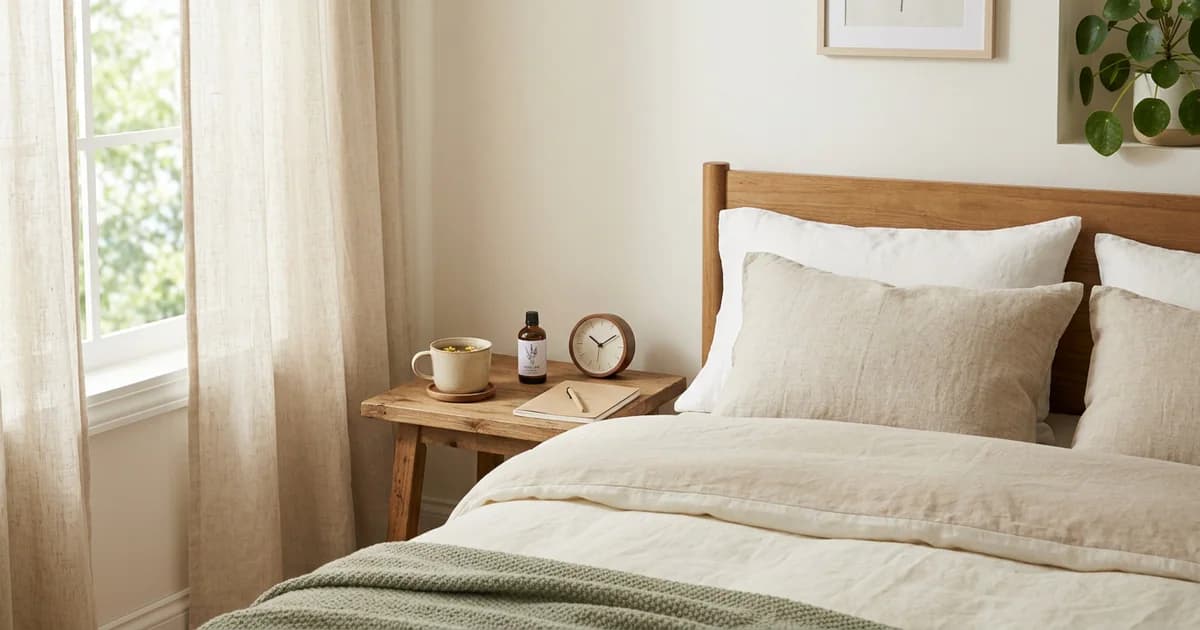
Sleep hygiene tips are daily habits, routines, and environmental conditions that support consistent, high-quality sleep. The most effective practices include keeping a fixed wake time every day, winding down 30-60 minutes before bed, cutting caffeine after 1-2 PM, and keeping your bedroom cool, dark, and quiet. Consistency applied daily is what makes them work.
- Keep a consistent wake time every day
- Wind down 30-60 minutes before bed
- Cut caffeine after 1-2 PM daily
- Keep your bedroom cool, dark, and quiet
- Limit screens 45-60 minutes before bedtime
You lie in bed staring at the ceiling. Your mind is racing, your phone is face-down on the nightstand but still tempting, and you know you have to be up in six hours. You've been here before. And the next morning feels exactly as rough as you expected.
Poor sleep isn't just a minor inconvenience. It drags down your mood, weakens your focus, raises stress hormones, and over time takes a real toll on your physical health. Research from sleep scientist Matthew Walker shows that even one night of bad sleep affects everything from memory consolidation to immune function. Yet most of us treat sleep as the thing we do after we've finished everything else — rather than as something worth actually investing in.
That's where sleep hygiene comes in. Sleep hygiene is the collection of daily habits, routines, and environmental conditions that support consistent, high-quality sleep. The term might sound clinical, but the practices themselves are straightforward. This guide walks you through the most effective sleep hygiene tips — plus three products that can make a real difference: a science-based book to understand your sleep, blackout curtains to transform your bedroom, and a white noise machine to block out what shouldn't be keeping you up.
Quick overview: the best sleep hygiene tools at a glance
Why We Sleep — Matthew Walker
The best-researched, most compelling book on why sleep matters and how to fix yours.
View on Amazon →NICETOWN 100% Blackout Curtains
Thick, well-reviewed curtains that block nearly all light and reduce noise — a bedroom upgrade that actually works.
View on Amazon →LectroFan Classic White Noise Machine
Ten fan sounds and ten white noise variations with no looping — one of the most trusted machines for consistent sleep.
View on Amazon →What sleep hygiene actually means (and why most people get it wrong)
When people hear "sleep hygiene," they often picture one or two tips — don't drink coffee after 2 PM, don't use your phone in bed. And while those things matter, sleep hygiene is really about the full picture: the timing of your sleep, the environment you sleep in, what you do in the hours before bed, and how consistent your patterns are across the week.
The most common mistake is treating sleep hygiene as something you "try" when things get bad, rather than as a set of habits you maintain daily. Consistency is the thing that makes it work. Your body runs on a circadian rhythm — a roughly 24-hour biological clock that regulates when you feel alert and when you feel drowsy. When your habits support that rhythm, sleep comes naturally. When they fight it, you end up lying awake even when you're tired.
The following tips are drawn from sleep research and the evidence behind them is solid. You don't have to do all of them at once. Pick two or three to start, stay consistent for two weeks, and see how you feel.
The most effective sleep hygiene tips
1. Keep a consistent wake time — even on weekends
This is the single most powerful thing you can do for your sleep. Your wake time anchors your entire circadian rhythm. When you sleep in on weekends to "catch up," you're essentially giving yourself social jet lag — your body clock shifts, and Sunday night you can't fall asleep at your usual time, making Monday morning brutal.
Pick a wake time you can stick to seven days a week and hold to it. Your bedtime will naturally adjust within a few weeks as your body finds its rhythm. It feels restrictive at first, but most people notice a dramatic improvement in how quickly they fall asleep and how rested they feel.
2. Create a wind-down routine 30–60 minutes before bed
Your nervous system needs a transition period between "doing mode" and "sleeping mode." Going straight from a stressful work email or an intense TV show to lying in bed rarely works well. A simple wind-down routine signals to your brain that sleep is approaching.
This doesn't need to be elaborate. A warm shower, some light reading, a few minutes of stretching, or a calming herbal tea can all work. The goal is to lower arousal and reduce cortisol — the stress hormone that keeps you wired. For tea suggestions that specifically support this, our guide on the best herbal teas for relaxation and better sleep has some genuinely useful options.
3. Limit screen exposure in the evening
The blue light emitted by phones, tablets, and laptops suppresses melatonin — the hormone that makes you sleepy. But the bigger issue isn't actually the light. It's the content. Scrolling social media or watching gripping TV activates your brain in ways that make sleep harder to initiate.
A practical approach: set a screen cutoff 45–60 minutes before your target bedtime. If you can't commit to that, use blue light glasses or your device's night mode setting, and stick to passive, low-stakes content rather than anything emotionally stimulating.
4. Make your bedroom cold, dark, and quiet
Your core body temperature needs to drop by about 1–2°C to initiate sleep. A cool bedroom — around 65–68°F (18–20°C) — supports that process. Many people sleep in rooms that are simply too warm, especially in summer.
Darkness matters just as much. Even small amounts of light — a streetlamp through thin curtains, the glow of a standby LED — can interfere with melatonin production. Blackout curtains are one of the cheapest, most effective bedroom upgrades you can make. And for noise: if you can't eliminate it, masking it with a white noise machine is genuinely helpful (more on both products below).
5. Avoid caffeine after 1–2 PM
Caffeine has a half-life of around 5–7 hours. That means if you drink coffee at 3 PM, half of that caffeine is still active in your bloodstream at 8 or 9 PM. Most people dramatically underestimate how much this affects their sleep — not necessarily making it hard to fall asleep, but reducing the depth and quality of the sleep they do get.
This includes tea, energy drinks, and pre-workout supplements. If you're sensitive to caffeine, moving your cutoff to noon can make a noticeable difference within just a few days.
6. Don't lie in bed awake for long periods
If you can't sleep after about 20 minutes, get up. Go to a dimly lit room, do something calm and boring, and return to bed when you feel genuinely sleepy. This sounds counterintuitive, but it's based on solid behavioral sleep science: lying in bed awake trains your brain to associate your bed with wakefulness and frustration rather than sleep.
This technique — called stimulus control — is one of the most effective non-drug interventions for insomnia. The goal is to make your bed a place your brain automatically associates with sleep, not with thinking or worrying.
7. Watch your alcohol intake in the evenings
Alcohol is a sedative, so it can help you fall asleep faster. But it fragments sleep in the second half of the night, suppresses REM sleep, and typically causes you to wake earlier than you'd like. Many people who describe themselves as "light sleepers" are actually sleeping less well because of an evening drink or two.
This doesn't mean you have to stop drinking entirely. But if you're working on your sleep, it's worth experimenting with alcohol-free evenings for a couple of weeks to see the difference clearly.
8. Get natural light in the morning
Morning light exposure is the most powerful signal your body has to set its internal clock. Getting outside within an hour of waking — even on an overcast day — anchors your circadian rhythm and makes it easier to feel alert during the day and sleepy at the right time at night.
Ten to fifteen minutes outside is enough. It doesn't require a long walk. This habit pairs extremely well with a consistent wake time and is one of the fastest ways to reset a disrupted sleep schedule.
9. Reserve your bed for sleep (and sex only)
Working from bed, watching TV in bed, or spending long stretches scrolling on your phone in bed all blur the mental association between your bed and sleep. The more activities you do in bed, the weaker that association becomes.
If you work from home and your bedroom is your only comfortable space, try to at least keep a visual separation — work at a desk or table, not in or on your bed. The bed should mentally signal: this is where I sleep.
10. Manage stress and a racing mind deliberately
Anxiety and a busy mind are among the most common causes of difficulty falling and staying asleep. The problem is that telling yourself to "just stop thinking" doesn't work. You need an actual strategy.
Writing a brief to-do list or "worry dump" in a notebook before bed offloads mental tasks from active memory. Progressive muscle relaxation — slowly tensing and releasing muscle groups — activates the parasympathetic nervous system and genuinely helps. Breathing exercises (a slow inhale for four counts, hold for four, exhale for six) can lower heart rate and reduce the feeling of anxious alertness. If you're also dealing with anxiety that extends beyond sleep, our guide to the best essential oils for anxiety and stress relief covers some well-supported options worth exploring.
1. Why We Sleep — Matthew Walker
Why We Sleep
If you want to understand your sleep rather than just patch it, Why We Sleep by Matthew Walker is the book to read. Walker is a neuroscience professor and sleep researcher who spent decades studying what sleep does to the brain and body — and this book is his attempt to translate all of that into something accessible and urgent.
The book covers the full scope of sleep science: what happens during each stage of sleep, what chronic sleep deprivation does to your health over time, how dreams work, and what the research actually says about caffeine, alcohol, sleeping pills, and aging. It's comprehensive without being dry. Walker is a good writer, and he uses real cases and data to make the science feel concrete rather than abstract.
What makes it particularly useful for anyone working on their sleep hygiene is the "why." Most of us intellectually know we should sleep more, but we don't act on it because we haven't fully internalized how much sleep deprivation costs us. After reading this book, most people find their motivation to prioritize sleep is simply much higher. It changes your relationship to sleep from "something I probably should do more of" to "something I genuinely want to protect."
A few caveats: some of Walker's statistics have been criticized by other sleep researchers for being slightly overstated, and the book is more focused on informing you than on giving you a step-by-step behavioral plan. But as a foundation — something to read before or alongside trying the sleep hygiene tips in this guide — it's hard to beat.
- Deeply researched and compelling — changes how you think about sleep
- Covers everything from REM sleep to the effects of alcohol and caffeine
- Written in plain language without dumbing things down
- Genuinely motivating — most readers report sleeping more after reading it
- Some statistics have been contested — not all claims are equally solid
- Less practical/actionable than some readers expect — more science than how-to
2. NICETOWN 100% blackout curtains — block the light that's ruining your sleep
NICETOWN 100% Blackout Curtains
NICETOWN has been one of the most consistently well-reviewed blackout curtain brands on Amazon for years, and the reason is simple: they actually work. Their triple-weave fabric blocks out nearly all light — early morning sunlight, streetlamps, car headlights — without looking industrial or hospital-like. They come in a wide range of colors and sizes, which makes them practical for most bedrooms.
Light is one of the most underappreciated sleep disruptors. Even low-level light exposure during sleep can affect melatonin levels and reduce sleep quality, particularly in the second half of the night when you're in lighter sleep stages. If you live in a city, or your bedroom faces east and gets hit by the sun early in the morning, blackout curtains can be genuinely transformative. Many people who install them report sleeping 30–60 minutes longer without changing anything else.
Beyond blocking light, the triple-weave construction also provides some noise and thermal insulation — a bonus in both summer heat and winter cold. The curtains are machine washable, hang easily on standard rods, and hold their shape well over time. For the price — typically around $30–40 for a pair — they represent excellent value compared to what you'd pay for custom window treatments.
One practical note: to get full blackout effect, you need curtains that are slightly wider than your window and hang close to the ceiling. Light gaps at the sides and top are the main complaint from people who feel their blackout curtains "don't work" — it's usually a sizing or hanging issue rather than a product issue.
- Blocks the vast majority of light — noticeable difference from the first night
- Available in many sizes and colors to suit different rooms
- Provides minor noise reduction and thermal insulation as a bonus
- Machine washable and durable over time
- Strong value for the price
- Full blackout requires careful sizing — light gaps at edges if hung incorrectly
- Some colors may look slightly different in person than on screen
3. LectroFan Classic white noise machine — silence the noise you can't control
LectroFan Classic White Noise Machine
The LectroFan Classic is consistently rated among the best white noise machines available, and it earns that reputation for a few specific reasons. It has ten fan sounds and ten white/pink/brown noise variations — enough variety to find something that works for your ears. Crucially, the sounds are electronically generated rather than looped recordings, which means there are no repetitive patterns or awkward gaps that your brain can detect and get distracted by.
Noise is a major sleep disruptor for a lot of people — particularly those who live in apartments, near traffic, or with partners who snore. The problem isn't just loud noise; it's sudden changes in noise level. A car door slamming outside at 3 AM wakes you not because of the volume per se, but because of the sudden contrast. White noise works by raising your ambient noise floor slightly, making those sudden sounds less jarring relative to the background.
The LectroFan is compact (about the size of a hockey puck), runs on USB or AC power, and has a volume dial that gives you precise control. There's no timer to fiddle with if you want it running all night, though a sleep timer is available if you prefer that. The sound quality is genuinely good — not tinny or harsh — and many users report using it every night for years without issue.
It's particularly useful for shift workers, people with young children, light sleepers, and anyone who travels frequently. If you've tried white noise apps on your phone and found them helpful, a dedicated machine is a meaningful upgrade — the sound fills the room more evenly and you're not draining your phone battery or risking notifications waking you up.
- 20 sound options with no looping — sounds stay consistent all night
- Compact and well-built — genuinely portable
- Precise volume control via dial
- Works better than phone apps — fills the room properly
- Excellent long-term reliability (commonly used for years)
- Pricier than a phone app — but the quality difference is real
- No Bluetooth or smart home integration
How to choose the right sleep hygiene tools: a practical buying guide
You don't need to buy anything to improve your sleep hygiene. Most of the tips in this guide are free. But if you want to invest in something, it helps to think about where your sleep is actually breaking down before spending money.
If you struggle to fall asleep and your mind is racing, the issue is usually stress management, screen time, or inconsistent timing — none of which require a product. The Why We Sleep book is worth reading to understand what's happening, but the fix is behavioral.
If you wake up too early or feel unrested despite getting enough hours, light is often the culprit — especially in spring and summer when the sun rises early. Blackout curtains are the highest-impact investment for this problem and start at around $30 for a good pair.
If noise is waking you — traffic, a snoring partner, neighbors, or a baby — a white noise machine is worth every penny. Budget around $50 for a quality dedicated machine. It's the kind of purchase many people say they wish they'd made years earlier.
Price range overview: Sleep hygiene books ($12–25), blackout curtains ($25–60 per pair depending on size), white noise machines ($30–80 depending on features). None of these need to be expensive to be effective.
Before buying anything, spend two weeks just fixing your wake time and wind-down routine. These are free and often produce bigger results than any product. If you still have trouble after that, then identify your specific remaining problem (light, noise, or knowledge) and invest accordingly.
Also worth noting: good sleep habits support good habits in general. If you're working on building a healthier daily routine, our guide on how to build good habits that stick pairs well with this — consistent sleep is one of the foundations that makes every other habit easier to maintain.
Frequently asked questions about sleep hygiene tips
How long does it take to see results from improving sleep hygiene?
Most people notice some improvement within one to two weeks of consistent changes — particularly if they fix their wake time and reduce screen time before bed. Full adjustment of your circadian rhythm can take three to four weeks. Don't expect overnight results, but do expect a gradual and real improvement if you stay consistent. The key is not doing everything at once and then giving up when it's hard — pick one or two changes and hold them for at least two weeks before evaluating.
Does a white noise machine really help with sleep?
For many people, yes — especially if noise is a factor in their sleep problems. White noise works by masking sudden changes in ambient sound rather than making your room completely silent. Research on white noise and sleep is generally positive, showing reduced sleep onset time and fewer awakenings in noisy environments. It's not a magic fix for insomnia, but if you live somewhere noisy or are a light sleeper, it can make a meaningful difference.
Is it bad to use your phone as an alarm if you're trying to improve sleep hygiene?
The alarm itself isn't the problem — it's what you do with the phone before and after. Checking your phone immediately before sleep and immediately after waking up both work against good sleep hygiene. If keeping your phone in another room isn't realistic, at least use it in airplane mode overnight and don't check it for the first 10–15 minutes after waking. A dedicated alarm clock removes the temptation entirely, which is why many sleep coaches recommend it.
What's the single most important sleep hygiene tip?
Consistency of wake time. This is the one change that sleep researchers and clinicians agree on most strongly. Everything else — bedtime routines, light exposure, caffeine limits — builds on top of a stable wake time. If you can only do one thing, do that.
Can sleep hygiene fix insomnia?
It depends on the type and severity. For mild to moderate insomnia driven by poor habits or stress, improved sleep hygiene can be highly effective. For chronic insomnia, the most evidence-backed treatment is Cognitive Behavioral Therapy for Insomnia (CBT-I), which includes sleep hygiene but also addresses the thought patterns and behaviors that maintain insomnia over time. If your sleep problems are severe or have persisted for months, it's worth speaking with a doctor rather than relying solely on lifestyle changes.
The most effective sleep hygiene tips — consistent wake time, a proper wind-down routine, a cool dark bedroom, and limiting caffeine and screens — are all free. If you want to go further, Why We Sleep gives you the understanding to stay motivated, blackout curtains fix the light problem for around $30, and a LectroFan white noise machine handles noise disruption better than any app. Start with the habits, then layer in the tools if you need them.
Related Reads
- Creative Hobbies for Mental Health: Why Making Things Makes You Happy
- Does Minimalism Make You Happier? What Research Shows
- Best Herbal Teas for Relaxation
- Best Essential Oils for Anxiety
What the Research Shows
Decades of sleep science explain why consistent sleep hygiene matters so much: sleep actively repairs the brain and body rather than simply pausing them.
| Researcher | Institution | Key finding | Year |
|---|---|---|---|
| Matthew Walker | UC Berkeley | Deep (non-REM) sleep clears toxic beta-amyloid protein and consolidates memory; deprivation harms memory, immunity and mood | 2015 |
| Bryce Mander & Matthew Walker | UC Berkeley | People with similar beta-amyloid levels showed better memory when they got more deep sleep, suggesting deep sleep protects cognition | 2015 |
Matthew Walker and colleagues at UC Berkeley have shown that sleep is when the brain runs essential maintenance. During deep non-REM sleep, slow brain waves help wash away metabolic waste, including the beta-amyloid protein linked to Alzheimer's disease, and shift newly learned facts from the hippocampus into longer-term storage in the prefrontal cortex. Their work also links short or fragmented sleep to a weakened immune system, low mood and stronger cravings for junk food.
This is why the small, repeatable habits in this guide carry weight. A regular schedule, a cool dark room and avoiding late caffeine all protect the deep-sleep stages that do the heavy lifting. Walker's research even found that sleep-deprived people feel lonelier and withdraw socially, so good sleep hygiene supports your relationships and not just your energy.
Sources: UC Berkeley News: Poor sleep linked to Alzheimer's protein; UC Berkeley: Matthew Walker research profile.
Frequently Asked Questions
What is Sleep Hygiene Tips and why does it matter?
How can I start practicing sleep hygiene tips in my daily life?
Is there scientific evidence supporting sleep hygiene tips?
How long does it take to see results?
What are the most common mistakes to avoid?
Can sleep hygiene tips help with stress and anxiety?
Weekly happiness in your inbox
One practical idea every week. No spam and no miracle claims — just clear advice you can assess for yourself.
No spam. Unsubscribe anytime.
Marcel Kupures
Founder & Editor
Founder and editor of Get A Happy Life. Research references are linked where they are used, and product comparisons rely on public product information unless hands-on testing is explicitly documented.
Last updated: July 17, 2026
Want more happiness science?
Browse all our guides on mindfulness, gratitude, sleep, and well-being.
Read more guides