
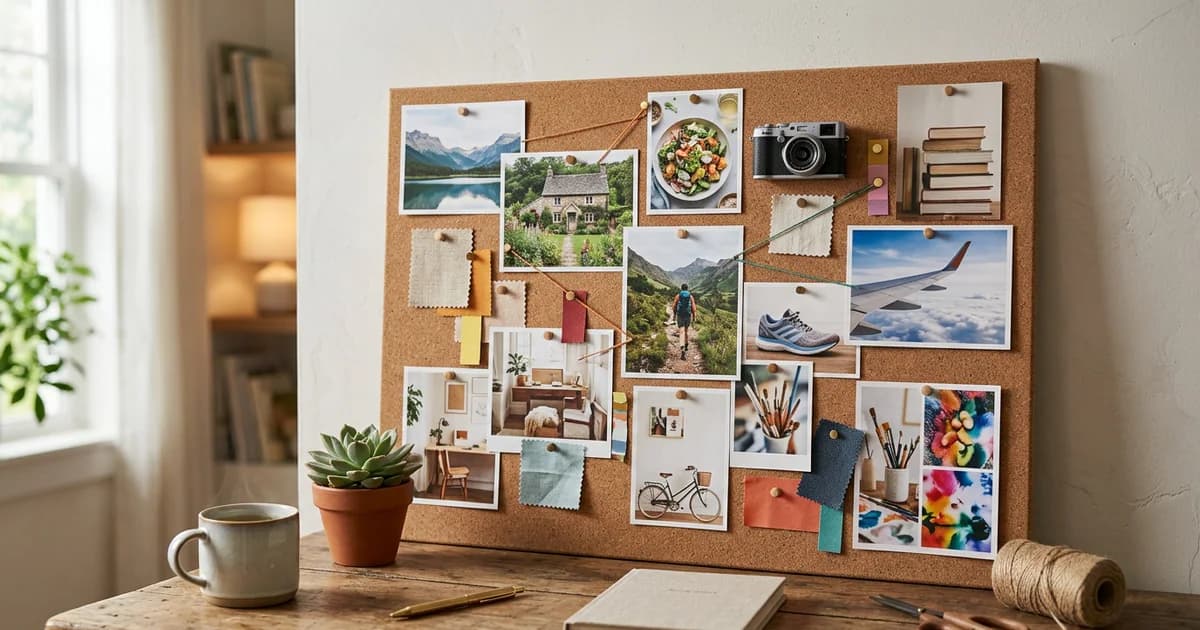
A vision board that actually works must be intentional, deeply personal, and connected to real daily habits. Visualization activates the same neural pathways as experiencing something, which is why daily exposure to your board shapes your choices and keeps goals in active awareness. The board works best when anchored in strong ideas that cover all life areas.
- Create intentional boards connected to real daily habits
- Visualization uses same neural pathways as real experience
- Daily exposure keeps your goals in active awareness
- Cover all life dimensions, not just one area
- Anchor board in strong, memorable, meaningful ideas
You've heard about vision boards. Maybe you've even tried making one before, cut out some pretty pictures, stuck them on cardboard, hung it on the wall, and then... nothing happened. A few months later you quietly took it down. Sound familiar?
Related reading: How to Set Goals and Achieve Them: A Science-Backed Framework
Here's the thing: most vision boards don't work because people make them the wrong way. It's not about gluing random "dream life" images together and hoping the universe handles the rest. A vision board that actually works is intentional, deeply personal, and connected to real daily habits. When done right, it's one of the most grounding practices you can build, and there's solid psychology behind why it works. Visualization activates the same neural pathways as actually experiencing something, which is why athletes have used it for decades.
In this guide, you'll learn exactly how to create a vision board step by step, what separates the boards that gather dust from the ones that genuinely shift your mindset, and which tools make the whole process easier and more enjoyable. Whether you want the classic cut-and-paste approach or prefer pairing your board with a structured manifestation journal, I've rounded up the best options to get you started.
Quick overview: best vision board tools at a glance

The Secret by Rhonda Byrne
The worldwide bestselling book that introduced millions to the law of attraction and the power of intentional visualization.
View price →
Think and Grow Rich by Napoleon Hill
A timeless classic that teaches the psychology of success and visualization, the perfect low-cost foundation for any vision board practice.
View price →
You Are a Badass by Jen Sincero
A wildly popular guide packed with blunt, uplifting wisdom and affirmations that bring clarity and fire to your intentions.
View price →
The Five Minute Journal by Intelligent Change
A beautifully structured daily journal that pairs perfectly with a vision board to keep gratitude and goals front of mind.
View price →
Start Where You Are by Meera Lee Patel
A widely loved self-exploration journal filled with prompts and vibrant illustrations to help you reshape your self-image.
View price →
The Artist's Way by Julia Cameron
The legendary 12-week creativity program that uses morning pages and artist dates to unlock your vision and dissolve creative blocks.
View price →
The 369 Manifestation Journal
A simple, affordable journal built around the popular 369 writing method to keep your intentions anchored every day.
View price →1. The Secret by Rhonda Byrne: the foundational manifestation bestseller
The Secret by Rhonda Byrne
The book that launched millions of manifestation practices worldwide, offering a complete framework for understanding how focused intention and visualization shape your experience.
View on Amazon →If you've been putting off making a vision board because you didn't know where to start, this book is the answer. It takes away the overwhelm by giving you a clear philosophy, think of it as the invisible kit behind every effective vision board. You sit down, read a chapter, and immediately understand why seeing your goals matters and how to choose intentions that actually resonate.
What makes this book stand out is that it's not just vague inspiration. Byrne breaks down how different areas of your life connect through a single principle: like attracts like. That structure is actually really valuable, because without it most people end up with a vision board that only reflects one dimension of what they want (usually money or travel) and misses the fuller picture of a happy life.
The stories and quotes throughout are memorable, which matters more than you might think. A vision board anchored in strong ideas is one you'll want to look at every single day. That daily exposure is where the real magic happens, not in some mystical way, but because it keeps your goals in your active awareness and subtly shapes your choices and attention throughout the day.
At around $13, this is a genuinely good investment for something that could shift how you think about your future. It also makes a thoughtful gift for a friend who's going through a life transition or setting intentions for a new chapter.
- Everything in one philosophy, no separate shopping needed
- Structured ideas help you cover all life areas
- Memorable concepts you'll enjoy returning to
- Great for complete beginners
- Less tactile than cutting images from magazines
- Some readers want more worksheets and step-by-step exercises
2. Think and Grow Rich by Napoleon Hill: the budget-friendly classic
Think and Grow Rich by Napoleon Hill
A no-fuss classic that walks you through the complete psychology of achievement, from clarifying your desires to imprinting them on your subconscious through repetition.
View on Amazon →For under ten dollars, this book gives you a solid foundation in the theory and practice behind successful visualization. If you're the type of person who likes to understand the "why" before you dive into the "how", this guide is a great first step. It explains not just how to build a vision board but also the psychological principles that make the practice work, which helps you engage with it more seriously rather than writing it off as wishful thinking.
The book is widely available in paperback and ebook, meaning you can start reading it tonight, without waiting for materials to arrive. It covers everything from choosing your goals and selecting images to where to place your board and how often to engage with it. Hill's emphasis on definite chief aims and autosuggestion pairs naturally with vision boarding.
What I like about this as a starting point is that it's low commitment. For the price of a coffee, you can decide whether intentional visualization resonates with you before spending more on journals or supplies. Many people find that reading through a guide like this first means their actual vision board is much more focused and intentional.
Pair it with some magazines, a piece of cork board, and a glue stick you already have at home, and you've got everything you need for a genuinely meaningful session.
- Incredibly affordable, great entry point
- Instant digital access or widely stocked in stores
- Explains the psychology, not just the steps
- Pairs well with any physical materials you choose
- No physical materials included
- First published in 1937, some language feels dated
3. You Are a Badass by Jen Sincero: for words that actually mean something
You Are a Badass by Jen Sincero
A wildly popular, bluntly uplifting guide packed with affirmations and mindset shifts designed to add fire and clarity to your vision board.
View on Amazon →A vision board without the right inner dialogue can feel a little flat. Images tell you where you want to go, but words remind you who you want to become. That's where this book comes in. Sincero's writing is specifically designed to jar you out of self-doubt, which means the language is aspirational, actionable, and formatted to make an impact every time you revisit your intentions.
Research in positive psychology consistently shows that affirmations and goal-related language can shift our self-perception over time, especially when we encounter them frequently. Keeping phrases like "I am a badass" or "What you think, you become" somewhere visible isn't just decoration. It's a subtle daily nudge to your brain about who you're becoming.
This is particularly useful if you find cutting words out of magazines frustrating, the font is tiny, the word you want is never in the right place, and it ends up looking like a ransom note. Sincero's chapters give you an entire vocabulary of intention. The writing is direct and funny, which means your vision board practice feels energizing rather than solemn.
At around $15 it's a mid-range pick, but if you're someone who needs a motivational push rather than gentle meditation, it's worth it. This is also something you'd return to when you update your board for a new year or new chapter.
- Professionally candid, inspires action
- Saves hours of frustrating magazine cutting
- Language is specifically chosen for building confidence
- Reusable across multiple board updates
- Brash tone may not suit every reader
- Pre-selected insights may not cover everything personal to you
4. The Five Minute Journal by Intelligent Change: the daily practice that makes your board work
The Five Minute Journal by Intelligent Change
A structured daily journal that helps you translate your vision board's images into written gratitude, intentions, and action steps.
View on Amazon →Here's what separates people who create a vision board and forget about it from people who actually move toward their goals: a daily writing practice. Looking at your board is step one. Writing about what you want, as well as what you're already grateful for, is step two, and it's the step most people skip.
The Five Minute Journal gives you a structured morning and evening format to do exactly that. Instead of staring at a blank page and wondering what to write, you're guided through prompts that help you visualize your goals, identify how you'd feel once you've achieved them, and spot the small actions you can take today. That combination of gratitude and intention is what makes goal-setting work in practice rather than just in theory.
The journal works beautifully alongside your vision board. Spend two minutes looking at your board in the morning, then five minutes writing in your journal. That seven-minute ritual can genuinely change how you approach your day: it's not about magical thinking, it's about priming your attention and keeping your priorities front of mind.
It's a solid, well-designed journal at a fair price. If you're already committed to making vision boarding a real habit rather than a one-off craft activity, this is the companion tool that makes it stick. You might also enjoy pairing it with our guide on art therapy benefits, which explores how creative self-expression supports mental wellbeing.
- Structured prompts remove the blank page problem
- Morning and evening format builds consistency
- Backed by positive psychology research
- Encourages both feeling-based and action-based thinking
- Requires daily commitment to get the full benefit
- Some prompts may feel repetitive over time
5. Start Where You Are by Meera Lee Patel: the identity-shifting journal
Start Where You Are by Meera Lee Patel
A widely praised, illustrated self-exploration journal centred on prompts that help you reshape your self-image alongside a vision board.
View on Amazon →This journal has become a favorite in the wellness world, and once you work through a few pages, it's easy to see why. The core idea is deceptively simple: instead of saying "I want to be healthy", you explore what being healthy looks like for you through writing, list-making, and imaginative prompts. This shift from wanting to understanding is one of the most well-documented techniques in psychology for rewiring your sense of self.
Your vision board shows you where you want to go. This journal helps you become the person who belongs in that picture. And that inner shift, updating your self-concept, is often the missing piece for people who make vision boards but don't follow through. If you unconsciously believe you're not the kind of person who achieves big things, no amount of pretty images will override that belief. This journal works directly on that.
The prompts feel gentle at first, especially if you're skeptical. That's completely normal. Most people find that after a week or two of returning to the pages daily, something genuinely shifts, not because of magic, but because repetition and intentional attention are how the brain updates its models of reality. This is also why journaling works better when done by hand than when just thought.
At around $13, this is one of the best value options in the list. It's a particularly good match if you already have physical vision board materials and just need the writing companion to activate them.
- Beautiful watercolor illustrations throughout
- Self-exploration framework targets self-concept, not just goals
- Affordable at around $13
- Works independently or as a vision board companion
- Open-ended prompts may feel too unstructured for some
- Less explicitly focused on action planning than other journals
6. The Artist's Way by Julia Cameron: the method with a cult following
The Artist's Way by Julia Cameron
The legendary 12-week creativity program that uses morning pages and artist dates to deepen your vision and dissolve blocks.
View on Amazon →If you've spent any time in creative or wellness circles, you've probably heard of The Artist's Way. First published decades ago, Cameron's 12-week program involves writing three pages every morning, "morning pages", and taking yourself on weekly "artist dates." Whether or not you consider yourself an artist, there's something genuinely useful here: it forces you to engage with your inner vision daily, which is far more than most people do.
This particular book gives you both the method and the philosophy behind it. That combination is more useful than just buying a blank journal, because the guide helps you write effectively, not vague rants, but specific, emotionally honest excavations that actually engage your focus.
The morning pages method works especially well alongside a vision board because they reinforce each other: your board provides the visual trigger, and the free-writing embeds the intention more deeply. Together they create multiple daily touchpoints with your goals, which is what actually shifts behaviour over time.
If you're someone who likes a defined system to follow rather than open-ended journaling, this is the pick for you. The 12-week structure removes decision fatigue and makes showing up consistently much easier. And consistency, more than any single big effort, is what vision boards are really about.
- Clear, structured 12-week program
- Guide + method in one, no need for two separate purchases
- Morning pages create strong habit reinforcement
- Complements visual vision boards perfectly
- The morning writing session can be hard to fit into a busy schedule
- Spiritual tone isn't for everyone
7. The 369 Manifestation Journal: affordable and widely used
The 369 Manifestation Journal
A no-frills, affordable journal at a great price, just the daily practice pages, ready to go.
View on Amazon →If you already know how the 369 method works and just want the journal without a guide, this is your best option. At around $10, it's the most affordable dedicated 369 journal in the list, and the format has a strong following among people who use it.
The layout is clean and uncomplicated: laid-out pages for your three morning, six midday, and nine evening writes, day after day. There's something genuinely satisfying about the physical act of writing by hand, it slows you down, it makes things feel real, and it creates a paper record of your intentions that you can look back on. Unlike an app that you close and forget, a physical journal sits on your desk and asks to be opened.
This journal also pairs well with Start Where You Are above. You could use one for your morning practice and one in the evening: they have different enough approaches that they'd complement rather than duplicate each other.
For anyone who is curious about the 369 method but not ready to commit to a full guide-and-journal combo, starting here is a smart move. If the practice resonates after a month, you can always add a more detailed guide later. If you're also looking for ways to boost your mood and motivation beyond journaling, our guide on how to increase serotonin naturally has eight science-backed approaches worth exploring.
- Simple, distraction-free format
- Most affordable 369 journal in the list
- Clean daily layout
- Great for people who already know the method
- No explanatory guide, beginners may want a companion book instead
- Purely writing-focused, no visual prompts
How to create a vision board that actually works: step by step
Now that you've seen the tools, let's talk about the process itself. Because even the best book won't help if your approach is off. Here's what actually makes a vision board effective.
Step 1: Get clear before you get creative. Before you touch a single magazine or image, spend 20 minutes writing. Ask yourself: what does my ideal life look and feel like in one year? In five years? Think across all areas, health, relationships, work, creativity, finances, personal growth. Avoid being vague. "I want to be happy" isn't a vision. "I wake up feeling rested and energised, I do work I find meaningful, and I have evenings free to cook and read": that's a vision.
Step 2: Gather images that feel true, not just aspirational. The biggest mistake people make is filling their board with images that belong to someone else's life. A superyacht, a model body, a corner office, if those don't genuinely connect to your values, they won't inspire you. Look for images that make you feel something real: warmth, calm, excitement, freedom. Cut them from magazines, print them, or draw them.
Step 3: Add words with intention. Words anchor your images to meaning. Use quotes from books like You Are a Badass, cut text from magazines, or handwrite words that matter to you. Think values as much as goals: "peace", "enough", "brave", "present".
Step 4: Place your board where you'll see it daily. This is non-negotiable. A vision board in a drawer does nothing. Put it where you'll see it first thing in the morning, on your bedroom wall, beside your desk, or as your phone wallpaper if you go digital.
Don't just look at your board passively, spend 60 seconds each morning really seeing it. Pick one image, close your eyes, and feel what it would be like to already be living that reality. That brief, intentional visualization is what activates the psychological benefit.
Step 5: Pair it with a daily writing practice. This is where the journals above come in. Writing your intentions by hand, whether through affirmations, the 369 method, or free journaling, reinforces what your board shows you visually. The combination of seeing and writing is far more powerful than either alone.
Step 6: Update it as you grow. Your vision will evolve, and that's healthy. Revisit your board every few months and adjust it. Goals you've achieved deserve to be celebrated and replaced. A vision board is a living document, not a one-time craft project. Also check out these mindfulness books if you want to deepen the inner work that supports your vision board practice.
Finally, and this is honest advice, a vision board works when it's connected to real action. It's a reminder system and a motivational anchor. It won't deliver results on its own. The clarity and daily engagement it creates should translate into choices: saying yes to the right opportunities, saying no to distractions, and taking one small step toward your goals every single day. View more vision board books and tools on Amazon.com →
Frequently asked questions about vision boards
Do vision boards actually work?
Yes, but not in a magical way. The science behind vision boards is rooted in well-established psychology: visualization activates neural pathways similar to real experience, and keeping your goals visually present helps your brain notice relevant opportunities (this is called the reticular activating system). Vision boards work best when they're paired with regular reflection and real action steps, not treated as a passive wish list.
What should I put on my vision board?
Include images and words that represent how you want to feel, not just what you want to have. Cover different life areas: health and energy, relationships and connection, work and purpose, creativity, personal growth, and environment. Make sure each image genuinely resonates with you emotionally, if it doesn't give you a warm or excited feeling when you look at it, it probably doesn't belong on your board.
How often should I look at my vision board?
Ideally, once in the morning and once before bed. You don't need to stare at it for long, 60 to 90 seconds of focused, intentional looking is more valuable than five minutes of passive glancing. The key is consistency over intensity. Daily, brief, intentional engagement beats a weekly long session every time.
Should I make a physical or digital vision board?
Both work, it comes down to your lifestyle. A physical board on your wall is harder to ignore and has a tactile quality that many people find grounding. A digital board (using apps like Canva or Pinterest) is easier to update and can be set as your phone or desktop wallpaper so you see it multiple times a day. Many people do both: a physical board at home and a digital version as a phone wallpaper for on-the-go reminders.
When is the best time to make a vision board?
There's no single right time, but natural transition points work especially well, the new year, your birthday, the start of a new season, or any moment when you feel ready for a fresh chapter. What matters more than timing is your headspace: make your board when you feel calm, unhurried, and genuinely reflective. Put on some music you love, make a cup of tea, and give yourself a couple of hours without interruptions.
If you want one foundational book to get started, The Secret by Rhonda Byrne (around $13) gives you the core philosophy in one place. For the best journal to pair with your board, Start Where You Are by Meera Lee Patel (around $13) and The 369 Manifestation Journal (around $10) are both affordable and complementary. Remember: the board gets you clear, the daily writing practice makes it stick, you need both.
Related Reads
- 10 Science-Backed Habits for a Happier Life
- Why Sleep Is the Foundation of Happiness (And How to Get More of It)
- Best Planners for Productivity
- Best Gratitude Journals
What the Research Shows
Vision boards work best when they pair a clear picture of the goal with a realistic plan, and the research on goal-setting and visualization explains exactly why.
| Researcher | Institution | Key finding | Year |
|---|---|---|---|
| Gabriele Oettingen | New York University | Over 20+ years of studies, positive fantasies alone reduced motivation; "mental contrasting", pairing the dream with its real obstacles, significantly improved follow-through | 2014 |
| Gail Matthews | Dominican University of California | Participants who wrote down their goals, and especially those who shared weekly progress with a friend, achieved markedly more than those who only thought about their goals | 2015 |
Gabriele Oettingen's research at NYU offers an important caution for vision boards: simply visualizing a successful outcome can actually drain energy and resolve. Her solution, "mental contrasting" (the basis of her WOOP method, Wish, Outcome, Obstacle, Plan), shows that imagining the goal and then honestly anticipating the obstacles makes people far more likely to act and succeed.
Gail Matthews studied 267 people across many professions and found that writing goals down boosted achievement, with the biggest gains among those who also sent weekly progress updates to a friend, more than 70% of that group reported real progress versus about 35% of those who only kept goals in their heads. The takeaway: treat a vision board as a starting point, then add written goals, accountability, and a plan for the obstacles.
Sources: Dominican University (Matthews); Oettingen, Rethinking Positive Thinking.
Frequently Asked Questions
How long does it take for a vision board to actually work?
What are the most common mistakes when making a vision board?
Is there scientific evidence that vision boards work?
Can a vision board practice help with anxiety or depression?
How do I get started with a vision board today?
What if I don't see results immediately?
Weekly happiness in your inbox
One practical idea every week. No spam and no miracle claims, just clear advice you can assess for yourself.
No spam. Unsubscribe anytime.
Marcel Kupures
Founder & Editor
Founder and editor of Get A Happy Life. Research references are linked where they are used, and product comparisons rely on public product information unless hands-on testing is explicitly documented.
Last updated: September 17, 2026
Want more happiness science?
Browse all our guides on mindfulness, gratitude, sleep, and well-being.
Read more guides